
Confining a star with an invisible magnetic trap
From thermonuclear fusion to open magnetic traps and hybrid reactors, here is how our technology keeps fusion plasma confined long enough for the reactions that could power the world.
Fusion
Thermonuclear fusion is the process by which light atomic nuclei fuse to form heavier ones. During this fusion, part of the mass is converted into energy according to Einstein’s famous equation E=mc². Thermonuclear fusion is the source of energy for most stars, including our Sun.

Deep within the Sun, hydrogen nuclei gradually transform into helium nuclei. However, contrary to popular belief, this process does not occur rapidly, but very slowly. Although the temperature at the Sun’s core reaches approximately 15 million degrees, the probability of two protons colliding and subsequently fusing is extremely low. If the reactions occurred faster, the Sun would have exhausted its fuel in millions of years, not billions
So why is fusion sustained after all? The main reason is the immense density of matter and the colossal size of the star. The central regions of the Sun contain so many particles that even the extremely rare successful reactions, when added together, provide a gigantic release of energy. Furthermore, the plasma is held together by its own gravity: the immense pressure of the upper layers prevents the hot matter from scattering into space.
It is impossible to reproduce solar conditions on Earth. We cannot create matter of such density or hold it together with gravity. Therefore, we must take a different approach. If the plasma temperature is increased to tens or even hundreds of millions of degrees, the nuclei begin to move significantly faster. Their kinetic energy helps overcome mutual electrical repulsion, and the probability of thermonuclear fusion becomes significantly higher.
However, a new problem arises. At such temperatures, any substance is in a plasma state --- a mixture of free electrons and ions. No material container can withstand contact with plasma heated to hundreds of millions of degrees. Moreover, the plasma tends to expand and quickly leave the reaction zone.
To produce energy, it is not enough to simply heat the plasma. Three conditions must be met simultaneously: sufficient temperature, sufficient particle density, and sufficient residence time. If the plasma cools or disperses too quickly, the number of reactions will be too small, and less energy will be released than was expended to heat it.
Open magnetic traps
One of the earliest approaches in controlled thermonuclear fusion was the open magnetic traps, or magnetic mirrors. Their design is much simpler than that of tokamaks or stellarators: the plasma is confined not within a closed torus, but within a linear magnetic system.
Imagine a long cylindrical chamber with a magnetic field inside it. The field is relatively weak in the central part and significantly stronger at the ends. A charged particle moving along a field line simultaneously rotates rapidly around it. If the magnetic field changes sufficiently smoothly, the so-called adiabatic invariant --- the particle’s magnetic moment --- is conserved. When moving into a region of a stronger magnetic field, the energy of the particle’s rotational motion around the field line must increase to conserve the magnetic moment.
Since the total kinetic energy of the particle remains practically constant in this case, the increase in transverse energy occurs at the expense of a decrease in the energy of motion along the magnetic field. The particle’s longitudinal velocity gradually decreases and may eventually become zero. After that, the particle begins to move in the opposite direction.
Thus, the regions of enhanced magnetic field at the ends of the device act as a kind of magnetic mirror, reflecting a significant portion of the particles back into the central region. The particles move back and forth multiple times between these two mirrors, which is what keeps the plasma confined in an open magnetic trap.
In other words, upon entering the region of a strong magnetic field, part of the particle’s kinetic energy is “transferred” into its rotation around a field line. If this transfer is sufficient, the particle stops and is reflected back, much like a ball bouncing off an invisible magnetic wall. It is precisely this effect that underlies the operation of a magnetic mirror.
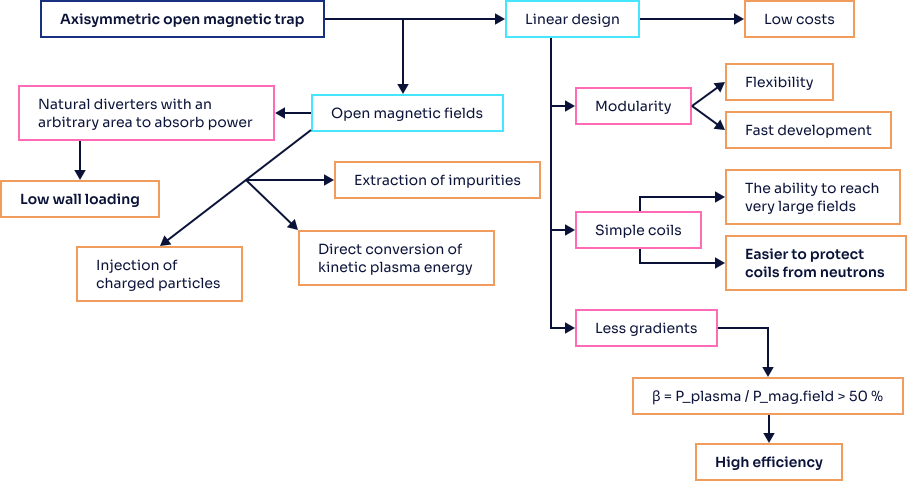
The main advantage of this design is its simplicity. The magnetic system consists of a linear setup to which heating, diagnostic, and energy extraction systems can be conveniently connected. However, a simple mirror trap faces a serious problem: some particles always have a sufficiently high velocity along the magnetic field and gradually escape through the ends of the setup. Due to these losses, the plasma confinement time is insufficient to create an effective fusion reactor.
Such traps were independently proposed in the United States by Richard Post and in the Soviet Union by Gersh Budker.


From a simple trap to a tandem trap
By the mid-1970s, it had become clear that a conventional magnetic mirror was unlikely to be able to provide the parameters required for an industrial fusion reactor. That was when the idea of a tandem (ambipolar) mirror emerged.
Instead of a single mirror system, it was proposed to use three regions: a long central chamber for the main fusion plasma and two special mirror sections at its edges. In these end sections, a hotter and denser plasma was created, forming electrostatic potential barriers. Such barriers further prevented particles from escaping the central region and significantly increased the confinement time.
The idea of the tandem mirror was proposed by a group led by Gennady Dimov at the Budker Institute of Nuclear Physics of the Siberian Branch of the USSR Academy of Sciences in Novosibirsk in 1975 and, independently, by Kenneth Fowler, David Baldwin, and Grant Logan at the Lawrence Livermore National Laboratory in the United States in 1976.
Tandem mirrors generated considerable interest in the late 1970s and early 1980s. In the United States, the TMX (Tandem Mirror Experiment) was built to test this idea, and it confirmed the feasibility of the concept’s basic principles.
Although the global fusion program subsequently shifted its focus to tokamaks, research on open traps did not cease. Their simple design, ease of maintenance, and the potential to create compact reactors make magnetic mirrors one of the most promising areas of fusion energy today. Modern projects employ new methods for plasma stabilization and confinement, building on ideas laid out by the pioneers of this field half a century ago.
Fusion-fission
Typically, when people talk about fusion energy, they are referring to reactors in which energy is released directly through the fusion of light nuclei. However, there is another approach: fusion–fission hybrid reactors, which combine fusion and fission technologies.

The idea behind such a reactor is that the fusion plasma is used not as the primary source of energy, but as a powerful source of neutrons. In the most promising fusion reaction between deuterium and tritium, an alpha particle and a fast neutron with an energy of about 14 MeV are produced. These neutrons possess significantly more energy than neutrons in conventional nuclear reactors.
A special shell --- the blanket --- containing fissionable or breeder materials surrounds the fusion facility. Upon entering the blanket, the fusion neutrons trigger nuclear reactions. Depending on the design, they can either initiate the fission of heavy nuclei, such as uranium or plutonium, or convert non-fissile isotopes, such as uranium-238 or thorium-232, into new nuclear fuel.
Thus, the thermonuclear part of the reactor acts as a kind of “neutron amplifier,” and the bulk of the energy can be released as a result of fission reactions.
The main advantage of this design is that the requirements for the thermonuclear plasma are significantly less stringent than in the case of a pure thermonuclear reactor. To generate electricity, it is not necessary to reach a state in which fusion fully sustains the plasma’s own heating. It is sufficient to maintain a steady stream of neutrons, which then triggers the much more energy-intensive fission processes in the surrounding blanket.
For this reason, many experts view hybrid reactors as a possible intermediate step between modern nuclear power and future fusion power plants. While creating a fully self-sustaining fusion reactor requires extreme plasma conditions and very long confinement times, a hybrid system requires more modest specifications.
Another important advantage relates to nuclear waste management. Fast fusion neutrons can effectively induce the fission of certain long-lived radioactive isotopes that do not “burn” well in conventional reactors. Therefore, hybrid systems are viewed as a potential tool for reducing the volume and radiotoxicity of nuclear waste.
At the same time, the hybrid reactor remains a subcritical system. Unlike a conventional nuclear reactor, where the chain reaction is self-sustaining, here its existence depends on an external neutron flux from a fusion source. If the fusion system is shut down, the neutron flux quickly disappears, and the fission reactions cease. This provides additional safety benefits.
Despite the appeal of the concept, the development of fusion–fission reactors remains a significant engineering challenge. It is necessary to simultaneously address the issues of confining hot plasma, protecting structural materials from a powerful flux of fast neutrons, heat removal, and the production of tritium for fusion fuel. Nevertheless, interest in hybrid systems has persisted for several decades, as they may become one of the most realistic ways to put fusion technologies to practical use even before the advent of full-scale fusion power plants.